Discussion Between Outside Directors
Toward the Creation of a Sound Corporate Culture that Respects Diversity
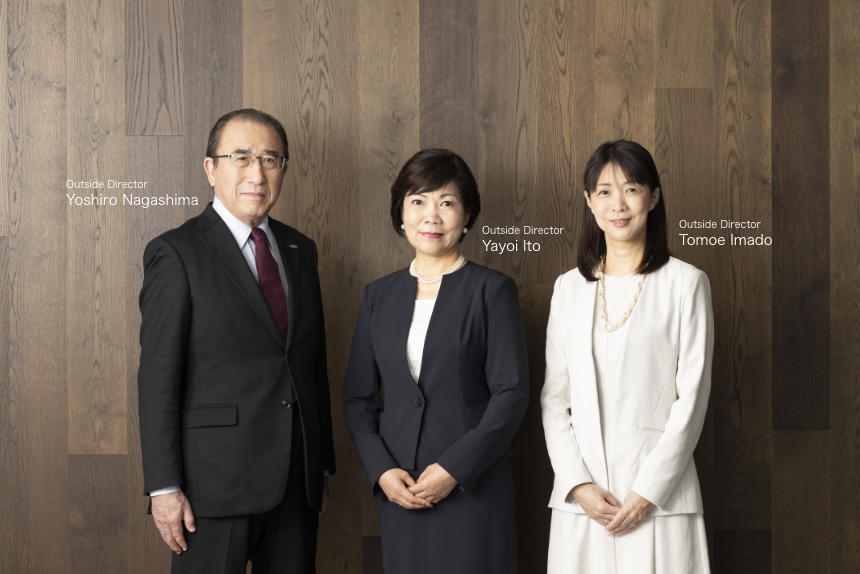
The Kanaden Group is committed to strengthening its corporate governance to fulfill its responsibilities to diverse stakeholders as a company that broadly supports society and industry. The three outside directors discussed the various challenges facing the group, including the role of the board of directors as the driving force behind these efforts.
Comments on the operation of the Board of Directors
Nagashima: I have served as an outside director of the Company for the past nine years. At the time of my appointment, the Board of Directors was mainly concerned with reporting on business execution rather than discussing new initiatives going forward. Recently, however, there has been an increase in deliberations requiring deep discussion, such as organizational reforms and new M&As, and the Board of Directors has become extremely active. What remained particularly impressive in this nine-year discussion was the case of the Solution Technology Division (hereafter, "the Division"), which was newly established six years ago in anticipation of the expansion of the solutions business. When it was initially established, the Division staff was accompanied by staff from the Sales division, and the head office was involved in the detailed operational issues / on-site issues. I pointed out that this operation did not allow the newly established Division to function adequately and recommended a division of roles between the Sales site and the Division. Now, the roles of each have become quite clear, and significant results have been achieved.
Ito: There are two points I keep in mind when speaking at the board of directors' meetings. The first point is that we make sure to express our views based on our experiences and background in IT and DX areas. The Company is also considering and introducing core systems and customer-management systems, but we are striving to actively advise on the process and operation of these systems. What is concerning is that there are few internal personnel who are knowledgeable and experienced in IT systems. I feel that digital human resources development is an urgent task for deepening discussions on the IT domain in the Board of Directors. The second point is recommendations for new business development, M&A, and collaboration. In particular, M&A and collaboration are frequently raised on the agenda of the Company. I have been actively speaking based on my previous experiences, including collaboration with foreign companies.
Imado: I often speak from the perspective of both my experience as a lawyer and my experience as a corporate officer. As you both pointed out, the recent agenda for the Company's Board of Directors frequently includes M&A proposals. In discussions on new projects-not just M&A-it is vital to discuss these issues from the perspectives of both Risks and Opportunities. As a lawyer, we provide advice on risk control with a strong awareness of "defense". There is a risk that should be taken to grow the business and a risk that should never be taken. We are making efforts to draw the attention of the executive side to ensure that this point is thoroughly selected. For projects where the risk appears to be particularly high, we may ask the executive side to review the detailed terms of the contract. My experience as an Outside Director of the Company is three years, but compared to the time of my appointment, the executive side seems to be increasingly engaging with the Board of Directors on opportunities. That's why I believe more effort is now being put into discussions at board meetings. Evaluation and Issues for Governance Features
Evaluation and Issues for Governance Features
Imado: On the governance side, the strengthening of group governance is a major issue for the future. As aggressive expansion into overseas markets and making a subsidiary through M&A become important options, it is a reality that the Group has yet to give sufficient consideration to Group governance. In particular, overseas operations present a risk that serves as a hotbed for misconduct, while Audit and other departments are also unable to directly oversee them all. This is a cause for concern. First of all, we should focus on carefully managing the risks of our foreign affiliates. In addition to "defensive" responses such as risk control, we also need "offensive" responses such as how to nurture acquired companies and contribute to enhancing the corporate value of the Group, and how to create a structure for this purpose. This is necessary to promote growth strategies for the entire Group, including M&A strategies, over the medium to long term. Regarding such group governance and the strategic development of overseas subsidiaries, the Company still lacks sufficient experience and should thoroughly discuss these matters going forward.
Ito: The Company does not seem to have a good grasp of driving the so-called PDCA cycle and driving it into growth while spiraling it up. At the Board of Executive Officers and the Growth Strategy Committee, we announce strategies for each business division, but there is an impression that historical reviews and discussions about issues and future strategies have not been met successfully, and that strategies are resetting each fiscal year. In order to lead the company to grow toward the stated goals, we should value the basic behavior of examining actions to be taken based on historical analyses and issues. Former President Motohashi also recognized these challenges and provided guidance to each business division, but improvements have been slow to materialize. Moving forward, under the leadership of New President Moriya, I ask that we continue striving to overcome these challenges while deepening discussions on the path that the Company should take, incorporating factors such as competitor movements and market trends.
Nagashima: I would like to point out two issues. The first point is the group governance that Ms. Imado pointed out. Both domestic and overseas subsidiaries that we have acquired have the impression of being "left alone". Going forward, I think it will be necessary to further strengthen management and to be more actively involved in on-site initiatives. One thing that has proceeded smoothly is the strength of the Audit Department. The Company's Audit department provides detailed audits, including legal compliance and money administration, which is highly evaluated. Going forward, I would like to see you focus on strengthening business management. The other point concerns the operation of the Compliance Committee and Risk Management Committee. Significant events are reported to the Board of Directors for Compliance and Risk Management, but we also need to discuss reporting and remedial measures for issues such as complaints, administrative errors, and incidents that occur in our daily operations. In the Committees, I think a system should be put in place to enable Outside executives to understand the content and advise them from a specialized perspective.
Improving the Effectiveness of the Board of Directors
Ito: While the Board of Directors is chaired by the president and fosters an atmosphere conducive to discussion, I believe it would be beneficial if it could serve as a forum for more in-depth discussions regarding the company's overall strategy. Outside Directors also attend the Board of Executive Officers and the Growth Strategy Committee, and we can ascertain the current status of operations, but there is not much discussion about the strategy itself. There are also two annual meetings where the Outside Directors and Audit & Supervisory Board Members come together. From the formulation stage of management planning, there are companies that engage Outside Directors in in-depth discussions, and I think it is good to learn from examples of such advanced companies. Regarding the Group-wide management strategy, I would like to see a forum for exchanging views with the Outside Directors.
Nagashima: To supplement Ms. Ito's comments, there are many business divisions in the case of the Company. The collection of business strategies, each of which is set out, is the basis for the company-wide management planning. At the annual Growth Strategy Meeting, we have a report on the annual business strategy developed by the respective business divisions, and we have an opportunity to give our feedback as Outside Directors. However, there are limitations to the development of the business strategy, which is the entry point, in terms of the details. At the same time, I believe it is crucial that we provide feedback on the strategies that have been completed at such meetings as the Growth Strategy Committee and the Board of Executive Officers. With regard to the Board of Directors, I feel that the number and quality of discussions on a single agenda item are increasing along with the development of the company. Sustainability has been a particularly deep debate. Outside Directors have also made many comments in the discussion of materiality in identifying preferred issues for environmental and social issues that are expected to occur in the future. It is difficult to face up to environmental issues from the standpoint of a trading company, but we have been able to discuss this and other issues.
Imado: Indeed, the Board of Directors has a well-designed agenda for critical management issues, including sustainability. I am also a member of the Sustainability Committee, but I had a very deep discussion in the committee on the identification of materiality. In the future, it will be an issue to set KGI and KPI for each materiality item and lead to specific actions. At the committee meetings, I felt that there was a strong awareness of the Board of Directors and the need to improve the effectiveness of the Board of Directors as a company. In addition, with regard to the business strategy that you both have pointed out, there is certainly an opportunity to express our views. However, in the future, in addition to discussing strategies for a single fiscal year, it will be crucial to have an opportunity to exchange views on how the long-term vision should be envisioned. If we provide a forum for discussion, rather than deliberation, the discussion of medium- to long-term growth-oriented opportunities will also increase in depth.
Recommendations for Management Issues Facing
Nagashima: I have observed the Company for a long time, but I recognize that in terms of business, we have entered a virtuous cycle. While there are issues in individual businesses, we are also using M&A to reform our business portfolio. By improving ROE, we are also improving PBR. On the other hand, there are also issues in terms of internal control. One big issue is the utilization of women. From a company-wide perspective, there are still few female managers, and we do not have enough female personnel who can move into a leading position. In this regard, efforts are needed to increase the number of female managers, including through mid-career hiring. Succession plan was also formulated last year, with Outside Directors playing a central role. Based on the plan, for a period of six months, we have appointed personnel who are considered potential successors for the President role for a 360-degree evaluation while receiving coaching from the incumbent. I think that by experiencing the new President’s selection process, progress has also been made on programs to train the succession plan and next-generation leaders.
Ito: I advise on human capital, including the formulation of the succession plan that you mentioned, based on my own experience and knowledge. Management executives and corporate officers need to have the ability to lead the company, as well as to express their views firmly to customers and outside stakeholders, and have a strong viewpoint that enables them to communicate well with other companies and industries. In this sense, I evaluate that we were able to successfully address this point through coaching in anticipation of the new President's appointment. We should devote more effort not only to management human resources development but also to initiatives to raise the level of our employees. In addition, while there were many business divisions that made it difficult for us to do so, we also need human resources who can conceive of collaboration for individual business divisions and cross-divisional businesses. As Mr. Nagashima pointed out, the Company needs to increase the number of female employees in order to increase the number of female managers. To do so, we should raise the name recognition of the company and make it more appealing that it is an attractive company. Securing IT human resources is also an urgent issue. Rather than focusing on specialized talent learned at large companies, it may be important to choose people that fit the size and business of the Company.
Imado: The coordination between business divisions that Ms. Ito pointed out is an important issue. On the executive side as well, we have been aware of the issue and have already taken measures, including the introduction of DX. As a result, we are in the process of establishing a system for cross-sectional communication through chats and other means, but we have not yet fully utilized this system. There is also a need to change the mindset of department managers. It's great that they are willing to take on new challenges, such as the introduction of new systems and the coaching that I mentioned earlier, but what may be lacking is leadership capable of making these challenges fruitful. In the future, if the Company aims to acquire a more colorful corporate culture than ever before, I think it will be crucial to incorporate a diverse range of human resources, including women.